
Light is the single biggest factor that drives most problems for indoor plants. It powers photosynthesis, so when light is wrong, growth slows or shows clear signs like stretching, pale leaves or scorch.
Set expectations fast: you’ll learn the common slip-ups and how to fix them in a normal Australian home. We focus on what you can control today — where you place your plant, how close it sits to a window, and when extra lighting is worth it.
We promise quick wins you can do in 60 seconds: look for strong shadows, check leaf angle, notice stretching. Then we cover longer tweaks for steady health.
Bright to your eyes isn’t always bright to plants. This section will translate indoor light into practical placement rules you can use straight away.
Preview: the six mistakes include too little light, too much light, wrong window direction, confusing low-light tolerant with low-light loving, relying on ambient room light, and misusing grow lights and hours. You don’t need a greenhouse — just better decisions with the light you already have. 🙂
For hands-on care and low-effort options, see our houseplant lighting guide for more tips.
Table of Contents
Key Takeaways
- Light controls growth; small changes make big differences.
- Do a 60‑second check: shadows, leaf angle, stretching.
- Use simple placement rules rather than guesswork.
- Know the six common mistakes and how to fix them.
- You can improve plant health without perfect windows.
Why light is your plant’s lifeblood at home
Think of light as the fuel your plants use every day to build leaves and roots. Without it, the whole growth engine slows and the plant’s reserves run low.
Photosynthesis basics: how sunlight becomes growth energy
Plainly: light + water + CO₂ = oxygen + sugars. Those sugars are the stored energy that make new leaves, roots and visible growth.
Why “no-light” plants don’t actually thrive long term
Some plants tolerate dim spots, but they still need usable light. “Low-light tolerant” means surviving. Low-light loving means actually growing. If leaves fade or space out, it’s usually a light problem, not a fertiliser one.
How light links to watering needs and overall health
Less light = less photosynthesis = less water use. That raises the risk of overwatering, root rot and pest issues in cooler months.
“When light drops, everything else—watering, feeding and pest resistance—gets wobblier.”
Quick self-check: shrinking leaves, pale foliage or long gaps between leaves often point to not enough light. Once you understand this, the fixes become simpler and more predictable.
How to assess the light in your space before moving a plant
Watching how sunlight travels through your space tells you more than a quick glance. Spend a day observing where the strongest light lands, how long it lasts and how far it reaches into the room.
Light intensity vs duration: what matters
Intensity is how bright a spot is. Duration is how many hours it gets that brightness.
A bright burst for 30 minutes is not the same as medium light all day. Plants use both the strength and the hours to make growth decisions.
What changes indoor light: common blockers
Check for verandah eaves, street trees, neighbouring buildings, flyscreens and tinted glass. These often cut the usable amount of light for parts of the day.
Room depth matters too — open‑plan and deep rooms let less light travel to inner areas.
Distance from a window: the simple rule
Every step back from the glass can drop usable light sharply. A spot that feels bright to you may not give enough light for growth once a plant sits a metre away.
- Read the room: watch where sun patches move across morning and arvo.
- Test for a week: take two quick photos (morning and afternoon) to compare patterns.
- Record the hours: note how long a chosen area sees direct or strong indirect light.
Once you know intensity + hours + distance, the labels low/medium/bright start to make sense. For plant picks that cope with different conditions, see our low-maintenance plants list for easy matches. 😊
Understanding indoor light levels: low light, medium light and bright light
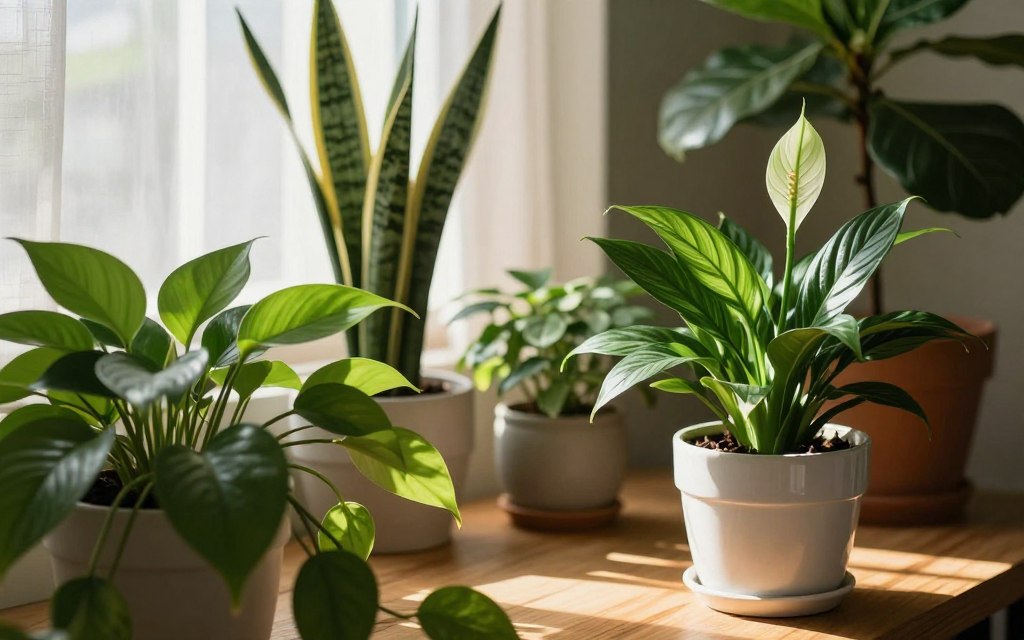
A plant’s success often comes down to which of four simple light types it gets. Picture each spot by how bright it feels and how long the sun (or bright sky) reaches it. That helps you match plants to the right place.
Low light: what it supports (and what it won’t)
Low light is like a room bright enough to read the paper on a cloudy day. It supports slow, steady foliage maintenance but rarely reliable flowering or fast growth.
Medium indirect light: the sweet spot
Medium light suits many tropical houseplants that evolved under a canopy. Think bright but filtered light that builds healthy leaves without burning them.
Bright indirect vs direct sunlight
Bright indirect light strengthens foliage. Direct sunlight or direct sun can scorch and bleach leaves on sensitive plants. Know which your plant tolerates before you move it into full sun.
High light for sun lovers
High light means long sun hours, warmer pots and faster drying soil. This amount favours cacti, succulents, herbs and flowering plants that need strong direct light to bloom.
| Light type | Effect | Good plant examples | Placement tip |
|---|---|---|---|
| Low light | Slow growth, steady foliage | ZZ plant, snake plant | Near inner room areas, away from strong sun |
| Medium indirect | Balanced growth, healthy leaves | Pothos, peace lily | Close to east or north windows, filtered |
| Bright indirect | Stronger foliage, few burns | Fiddle leaf fig, philodendron | Avoid midday direct light; use sheer curtain |
| High / direct | Fast growth, flowering or fruiting | Cacti, succulents, basil | Sunny sill with several hours of direct light |
Houseplant lighting guide for Australian homes: what your windows really provide
Look at each window as a different light source with its own daily rhythm and heat. That view makes placement easy. You’ll know which spots give gentle morning sun and which ones blast the hottest afternoon.
North-facing windows
What you see: steady, mostly indirect light that rarely produces long sun patches.
North-facing windows are indirect by default. If your room is deep or shaded by eaves, the usable light can still feel dim. Keep light-hungry plants closer to glass.
East-facing windows
What you see: a soft burst of morning sun, then bright-ish indirect light for the rest of the day.
East-facing windows are the gentlest option. They suit many plants because the sun is cooler in the morning and less likely to scorch leaves.
South-facing windows
What you see: long stretches of strong direct sun across the day in Australia — this is the big hitter.
South-facing windows deliver the most intense sun for the most hours. They’re ideal for succulents and sun-loving plants, but risky for rainforest species placed too close to glass.
West-facing windows
What you see: late afternoon sun that often equals the hottest part of the day.
West-facing windows give intense, warm afternoon sun. If you can feel the heat on your hand at the window in the arvo, your plant can probably feel it too. Use distance or a sheer curtain to avoid scorch.
Choosing placement
Rules you can follow:
- Right up to the glass for sun‑lovers that need direct sun.
- A few feet back for bright indirect light when direct sun is too strong.
- Behind a sheer curtain to filter harsh afternoon heat from west-facing window spots.
| Window direction | Typical effect | Best for | Placement tip |
|---|---|---|---|
| North | Steady indirect light, can be dim in deep rooms | Most foliage plants needing bright light without burn | Near glass or a few steps back if room is shaded |
| East | Morning sun, cooler and gentle | Many tropicals and delicate-leaf varieties | Close to window for morning sun; safe for many plants |
| South | Strong, long sun periods — highest intensity | Succulents, cacti, herbs that need direct sunlight | Right on the sill for sun lovers; provide shade for sensitive plants |
| West | Intense late sun; often the hottest part of the day | Heat-tolerant plants; move sensitive ones back or filter | Use distance or sheer curtains to reduce heat and scorch |
Mistake patterns that cause “getting enough light” problems
Two repeated pattern errors quietly ruin otherwise healthy plants. Fixing these clears up 80% of common problems fast.
Misreading “low light” labels
Low light on a tag often means the plant tolerates dim spots — not that it will flourish there. A low-light tolerant pot will survive, but growth may stall and stems thin out. You’ll get slow, sparse foliage instead of a lush look.
Relying on ambient room light
Downlights and bright interiors can trick you. If the plant can’t see the sky from its spot, it probably isn’t getting much usable light from a window. That’s a classic trap for houseplants in living rooms and hallways.
- Spot the difference: surviving vs thriving — check internode length and leaf colour.
- First fix: move the plant closer to windows for a week and watch for change.
- If moving isn’t possible, consider sensible supplemental light after placement.
| Pattern mistake | Why it matters | Quick fix |
|---|---|---|
| Misread “low light” | Plant survives but won’t grow well | Place nearer bright indirect spots; adjust expectations |
| Trusting ambient light | Room brightness ≠ usable plant light | Move to a window or test with a phone photo of sky view |
Tip: If you want to see if your pot is getting enough light, try the sky test — can you see the sky from where it sits? If not, it likely needs change. Once you stop these patterns, diagnosing leggy growth and scorch becomes much easier. 🙂
Mistake: too little light and slow, leggy growth
Leggy growth is your plant’s shorthand for ‘move me closer to the light.’ If stems stretch and older leaves look pale, that’s a clear signal.
Symptoms to spot
Pale or washed-out leaves, long spaces between leaf nodes and a pot that leans toward the nearest window are the typical signs.
Why it happens
Your plant sacrifices compact growth to reach usable light. That causes slower overall growth and smaller new leaves over time.
Practical fixes
- Move the pot closer to a window first, then rotate it weekly for even shape.
- Reassess after 2–4 weeks — look for stronger colour and fuller internodes.
- If your space stays dim, choose plants that cope better with low light rather than forcing a sun-lover to struggle.
Plants that cope better: snake plant, ZZ plant, pothos and many ferns — they tolerate lower light but still prefer some bright hours.
Quick checkpoint: if new leaves are noticeably smaller than older ones, boost the spot or switch species. In lower light you’ll water less often — let the mix dry to feel rather than a strict schedule. 😊
Mistake: too much light and direct sun scorch
Too much sun can show up fast — and often looks like baked, faded patches on leaves. That tells you the spot is hotter than the plant can handle.
Quick symptoms to spot
Bleached patches that look washed out. Crispy brown edges or tips. Some plants go purple or red when stressed.
Why it happens in Aussie homes
Glass concentrates heat. West-facing windows often deliver strong afternoon sun that overheats foliage not adapted to it. Even bright light can burn if the leaf is thin or tropical.
Three fixes you can try today
- Step back from the glass: move the pot a little further away to reduce intensity.
- Filter the sun: hang a sheer curtain to soften direct sun without darkening the room.
- Change windows: shift the plant to an east or north spot for gentler light.
More light isn’t always better. Bright light without direct sun often keeps tropical foliage safer and fuller.
Direct sunlight belongs to cacti, succulents and many culinary herbs that evolved for open sun. If you use very strong bulbs, keep the same distance rules — they can mimic scorch indoors. Don’t yo-yo a plant between dark and blazing spots; acclimate it slowly over a week.
For quick background on choosing the right spot, see our lighting basics, or read specific advice about species like Haworthia at Haworthia light advice.
Mistake: choosing the wrong window direction for the plant type
Pick the right window like you’d pick a climate — each direction has a personality that suits certain plants.
Stop guessing and match the plant’s origin to your window. That simple swap cuts most placement mistakes and speeds recovery when things go wrong.
Bright indirect light plants
Rainforest logic: many tropical species evolved under tree canopies. They want high brightness but need protection from hard, direct sunlight that burns thin leaves.
Place these plants a few feet back from strong sunbeams or behind a sheer curtain. That keeps high light without scorch.
Medium indirect light plants
Forest-floor logic: these plants grew in filtered, steady brightness. They dislike deep shade and they also hate hot sun patches.
Choose spots further back from the glass or where windows offer long, soft daylight. East and north windows often work well for medium light needs.
Direct light plants
Open-sky logic: succulents, many herbs and sun‑loving plants like long hours of direct sun close to a bright window.
Put them near the glass where they get maximum sun hours, but watch heat and airflow so pots don’t overheat. Rotate and check soil moisture more often.
- Quick room tips: a few feet back = bright indirect; further back = medium indirect; right up close = direct sun lovers.
- Track the sun’s path for part of a day to estimate actual sun hours your spot gets.
- Rule of thumb: if a plant is sold for flowers, fruit or culinary use, it usually needs more sun and more hours than leafy plants.
For care that pairs well with matching window spots, see our air-purifying plant care suggestions — they help you choose the right room and routine. 😊
Mistake: misusing grow lights and light bulbs
Supplemental lamps can rescue plants in dark corners — but only when used the right way. If your windows don’t deliver usable sun, smart artificial light fills the gap. Use it as a supplement, not a random room lamp.
When extra light helps
Use grow lights when windows are blocked by trees or buildings, in small apartments, or over gloomy winter months. They work well for pots placed far from glass or in rooms that never see strong sun.
Why LED options lead now
LED fixtures use less energy, run cooler and last far longer than older bulbs. A modern led grow panel gives useful spectra without the heat stress common with traditional options.
Quick bulb trade-offs and spectrum
- Fluorescent: moderately efficient and fine for seedlings or foliage.
- Incandescent: cheap but wasteful and hot — avoid for regular use.
- HPS/metal halide: powerful but bulky and usually overkill indoors.
Blue light favours leafy growth. Red helps flowering. A balanced white spectrum suits most everyday plant needs.
| Goal | Recommended type | Typical distance | Notes |
|---|---|---|---|
| Foliage growth | LED full-spectrum / fluorescent | 30–60 cm (12–24 in) | Lower heat, even growth |
| Flowering / fruit | LED with red boost | 15–30 cm (6–12 in) | Closer, monitor for stress |
| Seedlings / cuttings | Fluorescent or LED | 30–45 cm (12–18 in) | Gentle, steady hours |
| Low-cost temporary | Incandescent (not recommended) | Varies — avoid close | High heat, poor efficiency |
Practical final tips: set a timer for consistent hours, keep cords tidy, and place fixtures away from watering zones. Proper placement makes your grow lights a helpful part of healthy indoor plant care. 😊
Mistake: getting the “hours of light” wrong across the day
Plants notice hours, not just bursts — how long light lasts shapes growth. The total light in a 24‑hour period (the photoperiod) tells a plant when to grow, rest or set flowers.
Photoperiod basics: why duration matters as much as brightness
Photoperiod is simply the number of hours of light per day. A bright half-hour won’t match steady morning plus afternoon light.
Your plant cares about usable light time, not just a flash of brightness. Short hours slow growth. Long, consistent hours promote steady foliage or trigger flowering.
Timers for consistency: practical schedules
Use a simple timer to combine natural light and supplemental bulbs without guessing.
- Foliage plants: aim for ~12–14 hours total light each day.
- Flowering plants: aim for ~14–16 hours total light each day.
Start the timer so artificial light fills gaps in the morning or late afternoon — not blasting plants through their night rest. Consistency beats random on/off cycles every time. 😊
How light changes with seasons in Australia and what to adjust
Winter brings shorter days and less sunlight. If growth stalls, add a few hours with a timer rather than moving the pot constantly.
Summer brings stronger sun and hotter conditions. If leaves scorch from direct sun, reduce exposure or add a sheer filter rather than adding more hours.
“Stable hours of usable light help plants settle into healthy, predictable growth.”
Conclusion
Reading the light in your room is the skill that turns guesswork into steady plant wins. Use it to spot the six common mistakes — too little light, too much light, wrong window direction, misreading low light labels, trusting ambient room light, and misusing grow bulbs.
Start simple: reassess your window and distance first. Move one plant closer or farther, then watch for 2–4 weeks. That single step often changes results without spending a cent.
Two clear symptom buckets help fast checks: leggy or pale usually signals low light; bleached or crispy points to too much direct sunlight or very bright light. Adjust slowly and observe.
One more tip: learn basic light orientation with resources on light orientation. Once you can read light, choosing plants and keeping houseplants healthy becomes much easier. 😊
FAQ
What counts as low light for indoor plants?
Low light means a spot with no direct sun and limited bright hours — think a few metres back from a window or a shaded north-facing corner. Plants in low light get indirect, diffuse daylight for only part of the day. They survive but usually grow slowly and may become leggy. Choose tolerant species like snake plant or ZZ plant, or add supplemental LED grow lights if you want fuller growth.
How much bright indirect light do most tropical plants need?
Bright indirect light is strong, filtered daylight for several hours daily — near an east or north window or a few feet back from a south or west window with a sheer curtain. Aim for bright, even illumination without harsh midday sun. This level supports healthy foliage and steady growth without leaf scorch.
Is direct sunlight always bad for houseplants?
Not at all. Some plants—cacti, succulents and many herbs—thrive in direct sun. The problem is intensity: direct afternoon sun from a west-facing window is hottest and can burn delicate leaves. If leaves bleach, get brown edges, or develop purple stress colours, move the plant a little back from the glass or filter light with a curtain.
How do I measure light intensity in my home?
You can use a simple lux meter app on your phone (some are accurate enough) or a dedicated light meter. As a quick test, note how clearly you can read a book near the spot during the day: bright indirect light reads easily; low light is dim. Also watch plant behaviour—stretching, pale leaves or lots of new growth pointing towards the window are signs you need more usable light.
How many hours of light do indoor plants need each day?
It depends. Many foliage plants do well with 8–12 hours of usable daylight. Flowering and fruiting plants often need longer, and sun-lovers may require 12+ hours of strong light. If natural light is short, supplement with LED grow lights on a timer to keep photoperiods consistent through autumn and winter.
Can distance from the window turn bright light into low light?
Yes. Light drops quickly the farther a plant is from glass. A plant right on the sill may get bright or direct sun; a few metres back can be low light. Room depth, overhangs, other buildings and trees also lower usable light. If in doubt, move a plant closer temporarily to compare growth and leaf colour.
Which window direction is best in Australia for indoor plants?
Each aspect has pros and cons: north-facing windows give steady indirect light and are reliable; east-facing windows offer gentle morning sun and cooler afternoons; south-facing windows (in the southern hemisphere) tend to receive the strongest sunlight for many hours and suit sun-lovers; west-facing windows deliver late afternoon sun and can be the hottest part of the day. Match plant type to the window’s character.
When should I use grow lights, and which type is best?
Use supplemental lights when natural light is insufficient or inconsistent — deep rooms, winter months, or shaded apartments. LED grow lights are energy-efficient, long-lasting and run cool, so they’re the top pick. For foliage, a balanced white or full-spectrum LED works well; for flowering, ensure the fixture provides both blue and red wavelengths. Keep distance guidelines in mind to avoid heat and light stress.
How do I avoid overexposure to the hottest part of the day?
Protect sensitive plants from direct afternoon sun by moving them a little back from west-facing glass, using a sheer curtain, or placing them near an east or north window instead. Monitor leaves for bleached spots or brown edges and adjust placement before damage becomes severe.
Can ambient room light replace light from windows?
Ambient room light rarely substitutes for usable daylight. Artificial room lighting typically lacks the intensity and spectrum plants need. If windows don’t provide enough light, install purpose-built LED grow lights positioned to deliver adequate intensity and duration for your plant’s needs.
My plant is stretching and losing lower leaves — is it getting enough light?
Stretching (long internodes) and leaf drop are classic signs of too little usable light. Move the plant closer to a suitable window, rotate regularly so all sides get light, or add a grow light. Also check watering — low light reduces water needs, and overwatering in dim spots worsens decline.
How do light and watering needs connect?
Light drives growth and water use. In brighter spots plants transpire and use water faster; in low light they grow slowly and need less water. If you keep watering the same regardless of light level, roots can sit in damp soil and rot. Adjust watering to match the plant’s light conditions.
What distance should I keep between grow lights and plants?
Distance depends on the fixture’s output. As a rule, place low-power LEDs 15–30 cm above seedlings and young foliage plants; stronger fixtures can sit 30–60 cm away. Always check the manufacturer’s guidance and observe plants: wilting or bleached leaves mean the light is too close; slow stretching means it’s too far.
How does seasonal change affect indoor light and what should I adjust?
Seasonal shifts alter day length and sun angle. In winter you’ll get fewer and weaker daylight hours, so plants may need supplemental light or relocation nearer windows. In summer, the sun is higher and stronger — some spots may suddenly become too hot. Watch plants and tweak placement, shading or timers seasonally.
Which plants genuinely do well in low-light corners?
Low-light tolerant species include snake plant (Sansevieria), ZZ plant (Zamioculcas zamiifolia), pothos (Epipremnum aureum) and some ferns. They won’t match growth seen in brighter spots but will cope and add green to dim areas. For better results, give occasional bouts of brighter light or use a grow bulb.